Victoria’s 11-Year Inventory Peak: Why the Real Estate Standoff is Finally Over

1. Introduction: The End of the Real Estate Standoff
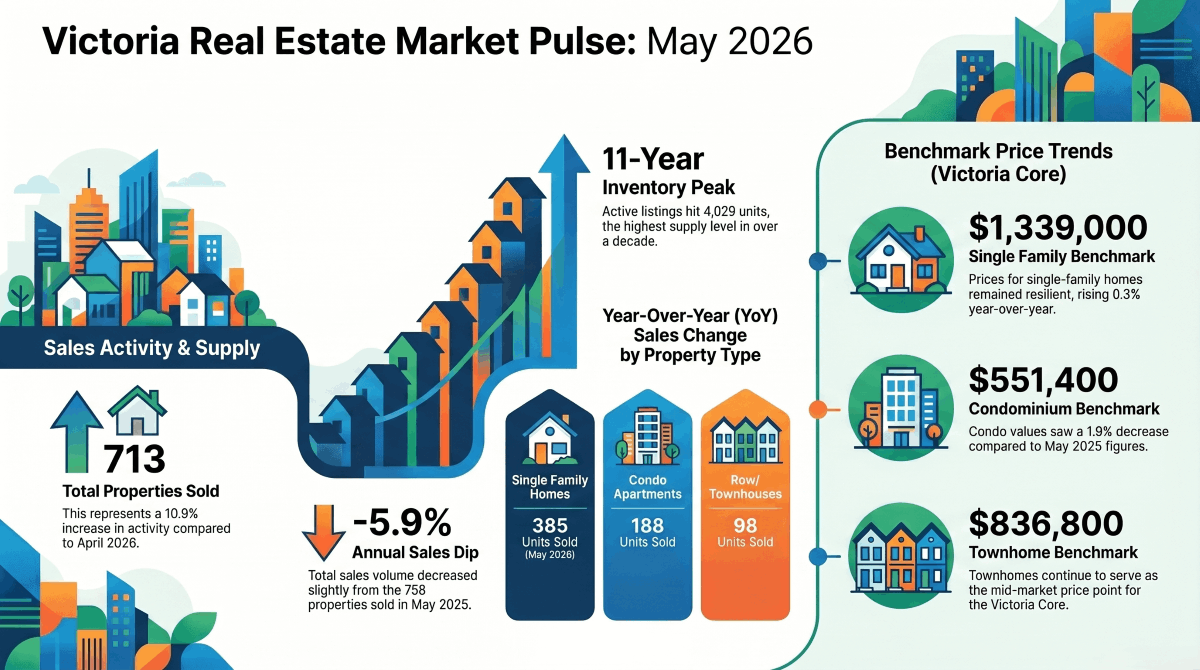
For the past year, the Victoria real estate market has been defined by a persistent "waiting game." Buyers were holding out for lower rates or better prices, while sellers remained hesitant to list. The data for May 2026 confirms that this standoff has officially dissolved. The spring market has arrived with notable momentum; while the 713 total properties sold represent a 5.9% decrease from May 2025, monthly sales activity surged by 10.9% compared to April. In fact, May’s 713 sales represent the second-highest monthly total in the last year, trailing only June 2025. This indicates a market that is no longer "on hold" but is transitioning into a new, higher-inventory reality.
2. A Decade-High Opportunity for Choice
The headline story of the current market is the unprecedented surge in supply. At the end of May 2026, active listings climbed to 4,029 units—a level not seen in eleven years. While the year-over-year increase of 8.4% is significant, the most striking data point is the 8.6% month-over-month increase in inventory. The fact that more inventory was added in the last 30 days than in the entire previous year underscores a rapid shift in market psychology. This abundance of choice has effectively transferred the advantage to the buyer, allowing for greater selectivity and a move away from the frantic pace of previous years.
“There’s no more waiting – the spring market is here. With the most inventory for sale our market has had in 11 years, we’re seeing buyers take advantage of the many homes available. Buyer expectations around pricing and features have changed with market conditions, and they have more time to make decisions and are viewing more properties.” — Fergus Kyne, Victoria Real Estate Board Chair.
3. The Widening Gap Between Single-Family and Living "Small"
As a Senior Analyst, it is crucial to look beyond the surface numbers. While the MLS® HPI benchmark values for the Victoria Core show a degree of stability, there is a clear divergence between property types:
- Single-Family Homes: Benchmark value rose to $1,339,000 (+0.3% YoY).
- Condominiums: Benchmark value fell to $551,400 (-1.9% YoY).
- Townhomes: Benchmark value fell to $836,800 (-1.9% YoY).
The "prestige" and inherent scarcity of single-family detached homes in the core continue to buoy benchmark prices. However, when we look at the Median Price for Single Family Total All Areas, we see a more pronounced decline—falling from 1,199,000 last May to **1,172,500 (-2.2%)** this May. This discrepancy highlights the value of the MLS® HPI in filtering out monthly fluctuations: while the "average" transaction price is trending down, the underlying value of a typical core home remains resilient, even as the "missing middle" and entry-level condo markets offer genuine price relief.
4. The 17.7% Threshold: Teetering on a True "Buyers' Market"
The Sales-to-Active Listings Ratio is the most accurate barometer of market power. By calculating total residential sales against active listings, we find a ratio of approximately 17.7%.
To put this in context, the BC Real Estate Association defines a Buyers' Market as any ratio below 17%. At 17.7%, Victoria is currently at its lowest point on the 25-month trend line. We are teetering on the edge of a downward-pressure environment on prices. This represents the most significant power shift in over two years, moving the needle firmly away from the sellers' markets that dominated the post-pandemic era and into a balanced posture that favours patient capital.
5. Regional Volatility: The Peninsula vs. The Gulf Islands
Strategic participants must recognize that "Victoria" is not a monolith; it is a collection of hyper-local sub-markets. We are seeing a "segmented success" model where specific neighbourhoods defy regional averages:
- The Peninsula: Single-family homes showed remarkable resilience, with benchmark prices rising 4.3% over the last 12 months.
- The Gulf Islands: Conversely, this sub-market experienced a sharp -7.9% correction.
The decline in the Gulf Islands should be viewed as an outlier correction—a natural cooling of pandemic-era premiums—while the Peninsula's growth proves that demand for specific lifestyle locations remains high despite broader cooling trends. Sellers in corrected areas must adjust their expectations immediately to find liquidity.
6. Conclusion: Success in the "New Normal"
The Victoria market has moved decisively from a "wait and see" posture to a "price and perform" environment. The 11-year inventory peak has removed the sense of urgency among buyers, making competitive pricing the mandatory entry fee for any seller to succeed. In this climate, the "winners" will be the buyers who leverage their increased selection and the sellers who display the pricing discipline required to stand out in a crowded field.
Closing Thought: At an 11-year inventory peak, does "winning" in real estate now depend more on buyer patience or seller pricing discipline?
Categories
Recent Posts